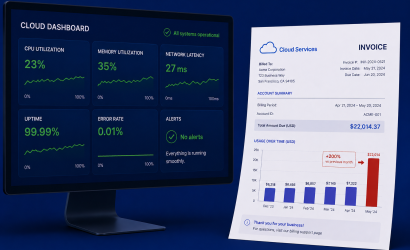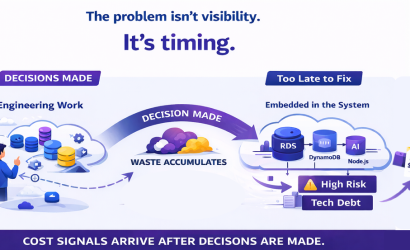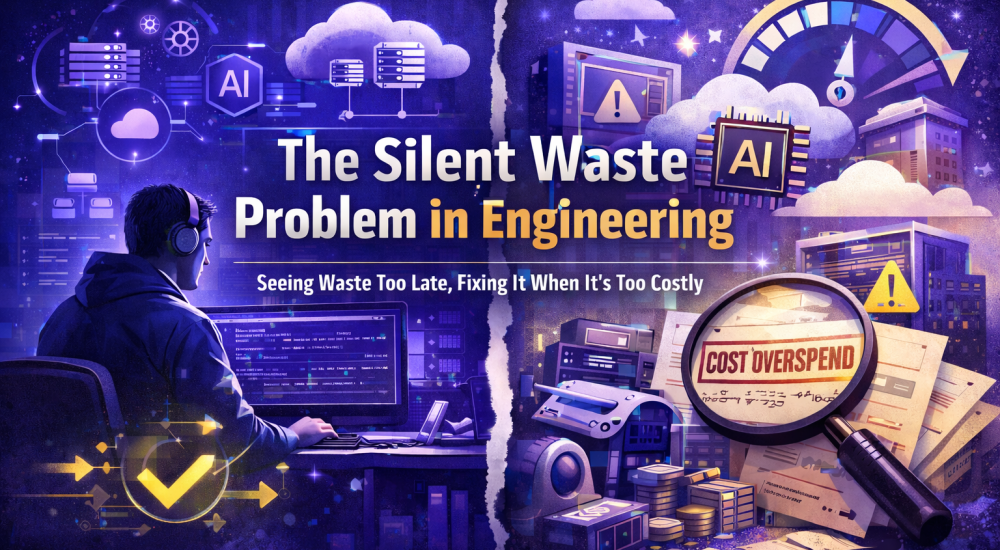
Engineering teams don’t see waste when they create it. They see it weeks later, when it’s already irreversible.
That delay is the real problem.
Most engineering waste doesn’t come from bad decisions. It comes from normal decisions made without visibility.
- A test environment left running after validation.
- An oversized configuration deployed “just to be safe.”
- An AI workload forgotten after experimentation.
- A storage volume created during debugging and never removed.
None of these is an engineering failure. They are the natural byproduct of these days’ engineering velocity.
And they exist in every organization.
Waste is a systems problem, not a people problem
Engineering teams today are optimized for:
- Speed of delivery
- Reliability
- Security
- Developer productivity
They are rarely optimized for:
- Awareness of infrastructure impact
- Awareness of AI usage impact
- Awareness of efficiency consequences
So the outcome is predictable: Engineers move fast. Infrastructure accumulates. Finance eventually reports the impact.
By then, the engineering context is gone, and nothing meaningful can be corrected.
This is not a discipline issue. It is a feedback gap.
Why most waste reduction efforts fall short
Most organizations try to address waste through:
- Cost dashboards
- Monthly reviews
- FinOps processes
- Tagging policies
- Budget alerts
These approaches help explain waste. They rarely prevent it.
Because they operate after consumption instead of during decision-making.
Engineering problems cannot be solved with delayed signals.
You would not improve reliability using last quarter’s incident reports.
You would not improve performance using metrics collected weeks later.
Yet this is still how most companies try to manage engineering waste.
The result is predictable:
Waste gets identified.
Waste gets explained.
Waste rarely gets prevented.
The real gap: engineers rarely see the impact of their decisions
Most waste originates in reasonable engineering tradeoffs:
- Choosing larger instances to reduce risk
- Keeping environments active during development
- Running AI experiments without usage visibility
- Duplicating infrastructure to move faster
The problem is not these decisions. The problem is the absence of immediate feedback.
Engineers rarely see:
- Whether the configuration is excessive
- Whether similar resources already exist
- Whether the AI workload is inefficient
- Whether the resource will remain idle
Without that awareness, waste is not surprising.
It is structural.
The shift beginning to emerge
Forward-looking organizations are starting to recognize something important:
Waste reduction cannot rely on financial processes alone. It must become an engineering capability.
This is driving a shift toward Real-Time Waste Prevention for Engineering – an approach focused on making efficiency visible while engineering work happens, not after it is completed.
The principle is straightforward: When engineers see impact while they still have context, they naturally make better decisions.
Not through enforcement.
Through awareness.
What changes when waste becomes an engineering signal
Organizations moving in this direction typically make three practical shifts:
- From delayed visibility to real-time awareness – Efficiency signals move closer to engineering workflows.
- From unclear ownership to clear accountability – Infrastructure is tied to responsible teams without relying on manual processes.
- From reactive cleanup to early correction – Issues are addressed when they appear, not weeks later.
These are not cultural changes.
They are systems changes.
Why this matters even more in the AI era
AI development is accelerating the problem.
Engineering teams now spin up AI workloads as easily as they provision compute. Prompts, model calls, token usage, and experimentation environments all introduce new forms of engineering waste. Traditional cloud cost tools were not designed for this reality. The problem is no longer just infrastructure efficiency. It is engineering efficiency across cloud and AI workflows.
And the same structural gap remains:
Engineers still rarely see the impact of these decisions when they make them. As engineering velocity increases, this gap becomes harder to ignore.
The missing layer in current engineering stacks
New engineering organizations already rely on systems that make critical signals visible:
- Observability platforms make reliability visible.
- Security platforms make exposure visible.
- Developer platforms make productivity visible.
Historically, no equivalent system existed to make engineering waste visible in real time.
Which meant efficiency remained dependent on retrospective analysis. That gap is now becoming increasingly apparent.
As engineering velocity increases, organizations are recognizing that efficiency must become part of engineering systems themselves – not something addressed later through reporting.
A new dimension of engineering maturity
Engineering maturity has traditionally been measured through:
- Reliability practices
- Security posture
- Deployment velocity
- Architecture quality
A new dimension is emerging: How effectively engineering systems prevent waste from being created in the first place.
Because the most mature organizations are not those that spend the least. They are the ones where inefficient decisions rarely survive long enough to matter. Not because engineers are more disciplined.
Because their systems make inefficiency visible early.
The direction engineering is heading
If the last decade was about making engineering faster, the next decade will be about making engineering more aware of impact. Not through more governance. Through better feedback.
Engineering organizations are moving toward systems where:
- Engineers understand consequences immediately
- Inefficiencies are visible early
- Waste is corrected naturally
- Efficiency becomes a property of the system itself
This is what Waste-Free Engineering starts to look like in practice. Not a finance initiative.
An engineering capability.
Final thought
Engineering teams do not intentionally create waste. They create it when systems fail to show consequences. The real question organizations should ask is not:
How do we reduce waste after we see it?
But: Why do our systems allow waste to be created without engineers knowing?
Because in current engineering environments, efficiency is no longer just about cost.
It is about how well engineering systems help teams make better decisions while they build.
And increasingly, that is becoming a defining characteristic of engineering maturity.