Every time an engineer provisions cloud infrastructure, triggers an AI agent, submits a prompt, or routes a workload through a model, they’re making a financial decision.
The problem is they have zero visibility into how much those decisions are actually going to cost.
The cost begins immediately.
Yet most organizations do not understand the financial impact until billing data arrives – hours, days, or weeks later.
By then:
- The money has already been spent.
- The resource may already be in production.
- The AI workload may have executed thousands of times.
- The engineer has moved to another task.
- Finance or FinOps must investigate what happened.
- Remediation requires tickets, messages, meetings, and follow-up.
This is why cloud and AI waste persists despite years of investment in dashboards, reports, alerts, and FinOps processes.
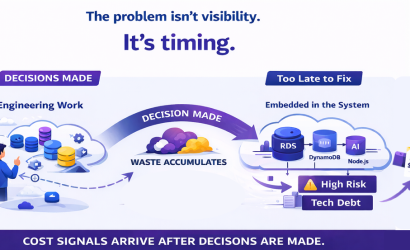
The problem is not visibility. The problem is timing.
Real-time AI and cloud cost optimization changes the sequence. It detects inefficiencies while they are being created, identifies the responsible owner, and brings the corrective action directly into the engineering workflow.
Instead of explaining yesterday’s mistakes, it helps prevent today’s waste.
What Is Real-Time AI and Cloud Cost Optimization?
Real-time AI and cloud cost optimization is the process of detecting, attributing, and correcting inefficient cloud infrastructure or AI usage while the associated engineering activity is still taking place.
It combines four capabilities:
- Cost intelligence before conventional billing data becomes available
- Automatic attribution to a user, team, project, application, or business entity
- Contextual recommendations based on technical and financial impact
- Immediate action inside Slack, Microsoft Teams, the IDE, or another engineering workflow
The objective is to reduce the time between the creation of an inefficiency and its correction – from days or weeks to seconds.
Atmoz is built around this principle. The platform detects AI and cloud inefficiencies as they are created, identifies the relevant owner, and enables immediate correction directly inside engineering workflows.
Why Traditional FinOps Identifies Waste Too Late
Traditional FinOps practices remain important. Organizations still need forecasting, allocation, budgeting, procurement, reporting, and accountability.
But most FinOps systems depend heavily on billing and usage data. That makes them naturally retrospective, as they analyze yesterday’s mistakes. They don’t prevent the waste. They analyze it.
The conventional process looks like this:
An engineer or DevOps makes a technical decision → usage accumulates → billing data becomes available → the cost is analyzed → the owner is investigated → a ticket is opened → Ticket needs to be assigned → the engineer is contacted → a correction is discussed – or not…
The process may yield an accurate diagnosis, but a diagnosis after the event cannot recover the money already spent.
This timing gap continues to have a significant financial impact. Flexera’s 2026 State of the Cloud report estimates that wasted cloud spend has increased to 29%, reversing a five-year downward trend. The same research found that generative AI had become the third-most widely used public cloud service, while organizations reported growing difficulty in forecasting unpredictable AI usage.
The problem, therefore, is not that organizations lack cost information.
The problem is that the information frequently reaches the people capable of acting only after the decision has been made and the cost has accumulated.
AI Has Made the Timing Gap More Dangerous
Cloud waste can build up over days or months. AI spend can escalate much faster.
An AI application or development environment may generate costs through:
- Input and output tokens
- Reasoning tokens
- Model API calls
- Repeated context
- AI coding assistants
- Agent loops
- Managed AI services
- GPU infrastructure
- Model-routing decisions
- Separate user and application subscriptions
A misconfigured cloud resource may waste money steadily. A malfunctioning AI agent can execute repeatedly and consume a substantial budget before anyone reviews a report.
AI spend is also harder to understand because a model invoice rarely provides the complete business context.
A technical and financial leader needs to know:
- Which user, agent, or application created the cost?
- Which project or customer should own it?
- What task was being performed?
- Was the selected model appropriate for the task?
- Was the context unnecessarily large?
- Was the usage expected or anomalous?
- Is the project likely to exceed its budget?
- What can be changed without reducing output quality?
The FinOps Foundation describes FinOps for AI as a response to cost complexity, faster development cycles, unpredictable spending, and the need for greater policy and governance. It emphasizes allocation, forecasting, optimization, and alignment between AI consumption, investment, and business value.
These requirements cannot be addressed through a monthly cloud-spend review, nor even a daily one.
AI financial management must operate at the moment AI is used.
What Is FinOps for AI?
FinOps for AI is the practice of managing and optimizing the cost and business value of AI models, infrastructure, agents, APIs, applications, and development tools.
It extends financial accountability beyond traditional infrastructure and into the individual activities that create AI consumption.
A mature FinOps-for-AI practice should be able to measure and manage:
- Cost per model, provider, agent, user, team, and project
- Token consumption and API calls
- Budget and quota utilization
- Cost per inference or business transaction
- Model-selection efficiency
- Agent anomalies and unexpected usage
- Forecasted month-end consumption
- The relationship between AI cost and business value
The FinOps Foundation specifically identifies metrics such as cost per inference, cost per token, cost per API call, resource-utilization efficiency, anomaly impact, and return on AI investment. It also notes that model selection matters because using an expensive model for a simple task can waste resources.
But measuring these metrics is only the first step. The larger opportunity is to use them while an engineer can still change the outcome.
From Cost Reporting to Cost Prevention
Traditional cost-management tools generally provide one or more of the following:
- Billing analysis
- Cost allocation
- Dashboards
- Anomaly reports
- Rightsizing recommendations
- Commitment recommendations
- Budget notifications
These capabilities help organizations understand their environments. But understanding an issue and resolving it are different activities and capabilities.
A recommendation sitting in a dashboard still requires someone to:
- Notice it
- Determine whether it matters
- Identify the owner
- Investigate the technical context
- Contact the engineer
- Explain the financial impact
- Request a change
- Confirm that the change was completed
In addition to all “standard” FinOps capabilities, Atmoz introduces an execution layer between cost intelligence and engineering action.
Its operating model is:
Identify an inefficient cloud resource or AI usage pattern while it is being created.
Find the responsible owner and deliver a contextual recommendation in Slack, Microsoft Teams, the IDE, or another existing workflow.
Allow the engineer to resolve the issue immediately, without beginning a separate investigation and ticketing process.
Detect. Fix. Move On.
The Atmoz workflow replaces the delayed sequence of billing, investigation, tickets, meetings, and escalation with intervention at the point where cost is created.
How Can Cloud Cost Be Calculated Before Billing Exists?
Real-time cost prevention requires solving a difficult technical problem: Data on what something is going to cost does not exist.
Atmoz addresses this through a proprietary data foundation.
The platform gathers live infrastructure and AI usage signals, combines them with pricing and technical context, and reconstructs the expected cost before the conventional bill is produced. It can then evaluate the current configuration against alternatives and calculate the financial impact of a possible optimization.
This creates a continuous loop:
Live cloud and AI metrics → reconstructed cost → ownership and context → recommendation → engineering action
The result is cost intelligence at the moment it is operationally useful – not only when it is financially reportable.
Atmoz’s architecture combines this data foundation with a real-time, context-aware control and remediation loop inside developer workflows.
Who Is Responsible for Fixing Cloud and AI Waste?
Cloud and AI cost management requires collaboration across Finance, FinOps, engineering, platform operations, and business leadership.
But the person who can correct a technical inefficiency is usually an engineer.
Finance may see that a bill has increased. FinOps may identify the affected service. A platform team may trace the resource. But the engineer frequently holds the context needed to decide whether a resource can be resized, a workload can be rescheduled, or a different AI model can be used.
That is why ownership is central to real-time optimization.
Every resource or AI workload should be linked to a verified:
- User
- Task
- Module
- Tool
- Department
- Engineering team
- Application
- Project
- Environment
- Business unit
- Customer or cost center
Without ownership, a recommendation becomes another item in a shared queue.
With ownership, it becomes an actionable engineering decision.
Bringing AI Cost Management into the IDE
AI coding tools have introduced another layer of technology spend that is often difficult to attribute and control.
Developers may use different tools, models, agents, extensions, and providers. The organization may know the total subscription or API cost but lack a clear view of how usage is distributed.
For every AI-assisted engineering activity, technical leaders should be able to answer:
- Who generated the usage?
- What project or task was involved?
- Which model was selected?
- How many tokens and API calls were consumed?
- Was the selected model necessary?
- Was the context optimized?
- Is the user or project approaching a limit?
- What is the predicted month-end cost?
- What does each task or project cost, and what is their value?
Tokenomix, the Atmoz AI cost-control and optimization module, brings these answers into the engineering workflow.
It is designed to monitor AI usage across tools and providers, allocate spending by owner, task and project, forecast usage against budgets, and recommend optimizations where developers work. Its current coverage includes environments such as Claude Code, Cursor, GitHub Copilot, AWS Bedrock, Gemini, and Microsoft AI Foundry.
Five AI Cost Problems Organizations Must Detect in Real Time
Runaway AI agents
An agent may enter an unintended loop or make far more model and API calls than expected.
Real-time control can identify the spike, determine which agent and owner are responsible, and recommend a limit or guardrail before the cost escalates.
Oversized context windows
AI coding and application workflows may repeatedly send large histories, files, or instructions that are not required for every call.
Reducing unnecessary context can lower token consumption without blocking the developer or materially affecting output quality.
Using the wrong model for the task
The most advanced model is not automatically the most appropriate model.
A costly model used for a low-complexity classification, extraction, or formatting task may provide little additional value. Model right-sizing aligns price, performance, quality, and the importance of the task.
Project budget overruns
A historical dashboard can show what a project has spent.
A real-time system should also forecast where current consumption is heading and alert the relevant owner before the budget is exceeded.
Unclear ownership
Usage generated under shared tools, agents, service accounts, or applications may be difficult to attribute.
Mapping consumption to users, teams, projects, and business entities creates accountability and supports cleaner chargeback and showback.
These use cases form part of the current Tokenomix cost-control framework.
Traditional FinOps Versus Real-Time AI and Cloud Efficiency
| Capability | Traditional FinOps | Real-Time AI and Cloud Efficiency |
| Primary data | Billing and usage data | Live cloud and AI signals |
| Timing | After spend accumulates | As usage and decisions occur |
| Main objective | Analyze and allocate cost | Prevent and correct inefficiency |
| Ownership | Often investigated manually | Automatically attributed |
| Workflow | Dashboards, reports, and tickets | Slack, Teams, IDE, and engineering tools |
| Remediation | Separate manual process | Embedded into the workflow |
| AI context | Often limited or fragmented | User, agent, model, team, task, and project |
| Feedback loop | Days or weeks | Immediate |
| Primary action owner | FinOps or Finance initiates | Engineer receives and acts, Executive supervision |
Does Cost Governance Slow Engineering Down?
It should not.
Poorly designed governance adds approval processes, mandatory meetings, manual tickets, and centralized bottlenecks.
Effective governance delivers:
- The right information
- To the right owner
- At the right time
- Inside the right workflow
- With a clear corrective action
An engineer or a DevOps professional should not need to become a cloud-pricing specialist or study an AI invoice.
The engineer or DevOps needs enough context to understand that a current decision is inefficient and what alternative is available.
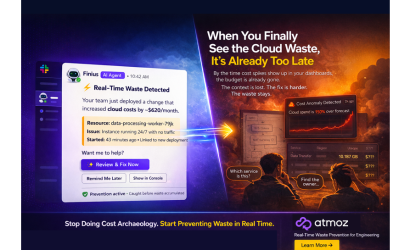
Atmoz’s Finius AI agent is designed for this interaction. Atmoz identifies the inefficiency, attributes ownership automatically, and Finius communicates with the relevant engineer, and enables correction directly inside the engineering workflow.
The aim is not to add another responsibility to engineering.
It is to remove the later investigations, tickets, and interruptions caused by unresolved, inefficient decisions.
What Results Can Real-Time Optimization Produce?
The value of real-time cost optimization lies in reducing the time during which waste remains active.
Atmoz customer materials report examples, including:
- More than $10,000 saved in the first 24 hours
- A 28% reduction in avoidable cloud spend in 4 weeks
- Inefficiencies surfaced within seconds
- Automatic ownership attribution
- Governance implemented without slowing engineering
The principle is simple.
A resource that wastes $1,000 per day incurs a $20,000 loss if it remains unresolved for 20 days. Detecting and correcting it at the first moment changes the financial outcome – not merely the quality of the report.
Real-time optimization also reduces the operational effort required to identify owners, create tickets, explain recommendations, and follow up with engineering teams.
Who Needs Real-Time AI and Cloud Cost Optimization?
The approach is particularly relevant for organizations with:
- Large or rapidly growing Cloud environments, including Azure, AWS, and GCP
- Multiple engineering teams or business units
- AI coding tools deployed across development teams
- Production applications using foundation models or AI agents
- Difficulty allocating AI or cloud spend
- Frequent cost anomalies or budget surprises
- Large backlogs of unresolved FinOps recommendations
- A need for financial governance without slowing development
The primary stakeholders are typically:
- CTOs and CIOs
- VPs of Engineering
- Heads of Platform Engineering
- DevOps and cloud-operations leaders
- AI platform leaders
- FinOps practitioners
- Engineering managers
Atmoz is a real-time AI and cloud efficiency platform that fixes inefficiencies before they hit production and the bill, using an agentless, read-only approach designed for enterprise environments.
The Future of FinOps Tools Is an Engineering Execution Layer
FinOps established the importance of financial visibility and shared accountability. The next step is to connect that visibility to execution.
That means moving:
- From retrospective analysis to real-time prevention
- From shared costs to verified ownership
- From dashboards to engineering workflows
- From recommendations to proactive, immediate remediation
- From monthly AI reporting to continuous usage control
- From financial investigation to informed engineering decisions
Cloud and AI costs happen while engineers work.
That is also when organizations have the best opportunity to control them.
The problem is not visibility. It is timing.
And when cost control operates at the same speed as engineering, organizations can reduce waste without slowing innovation.