There is a strange paradox at the heart of the AI revolution.
We keep making AI dramatically more efficient. Models require less compute. Inference costs are falling. Hardware is becoming more capable. Techniques such as quantization, distillation, batching, and better model architectures allow us to get more intelligence out of every unit of compute.
And yet, the amount of compute we consume keeps going up.
This isn’t necessarily a contradiction.
It may be an example of something economists have understood for more than 160 years: Jevons’ Paradox.
The paradox of efficiency
In 1865, English economist William Stanley Jevons observed something counterintuitive about coal.
As steam engines became more efficient, you might expect society to consume less coal. Instead, making coal-powered machines more efficient made them more economically attractive. Their use expanded, new applications became viable, and total coal consumption increased.
The important distinction is between resource consumption per unit of activity and total resource consumption.
If a task originally required 100 units of a resource and technological improvements reduce that to 10, we might assume consumption has fallen by 90%.
But what if the lower cost causes us to perform 20 times as many tasks?
We haven’t reduced consumption.
We’ve increased it.
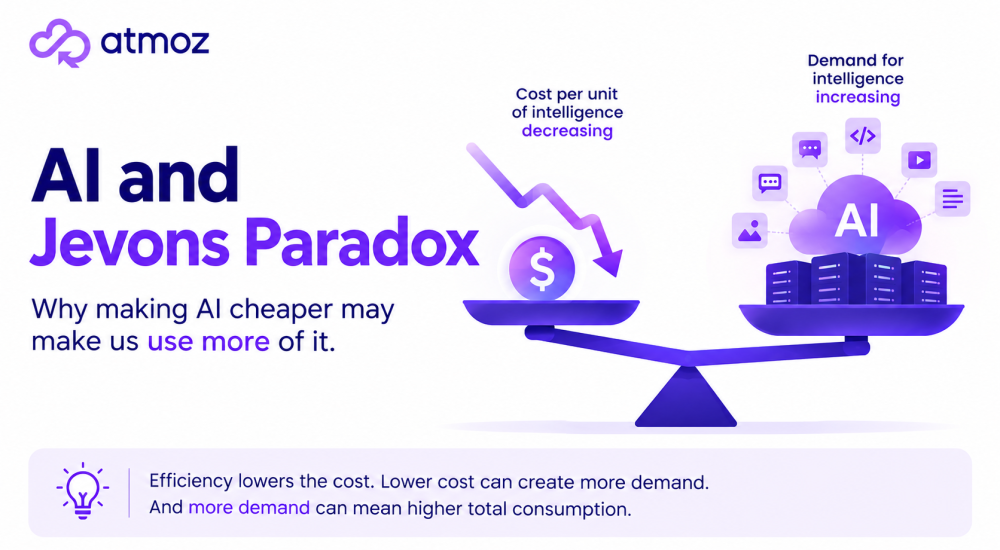
That is the essence of Jevons’ Paradox: efficiency can make a resource cheaper to use, and cheaper resources can create more demand.
And AI may be one of the clearest modern examples.
AI is getting dramatically cheaper
The efficiency improvements in AI are remarkable.
The amount of compute required to achieve a given level of capability has fallen substantially. Hardware has improved. Models have become smaller and more efficient. Inference optimization has accelerated. And the cost of accessing powerful models has fallen dramatically.
The IEA estimates that energy consumption per AI task has been declining at an extraordinary rate, with energy use for individual AI tasks falling by at least an order of magnitude annually in recent years.
That sounds like fantastic news.
And it is — per task.
But that’s only half of the equation.
The other half is: how many tasks are we now willing to perform?
When something becomes cheap enough, we stop conserving it
Think about storage.
When storage was expensive, you carefully managed your files. You deleted things. You compressed photos. You worried about disk space.
Then storage became incredibly cheap.
Did we start using less storage?
Of course not.
We started taking more photos, recording more video, keeping more files, backing everything up, and eventually storing enormous amounts of data that we would never have considered keeping before.
The same thing happens with compute.
When AI inference costs $1, you think carefully about whether a task is worth doing.
When it costs $0.01, you automate it.
When it costs $0.0001, you don’t even think about the cost.
And when it becomes effectively negligible, you start putting AI everywhere.
That is where the economics become interesting.
AI doesn’t just make existing tasks cheaper
The biggest source of AI’s potential rebound effect isn’t necessarily that people will run the same chatbot 100 times more often.
It is that AI enables entirely new categories of computation.
Consider software development.
A developer might previously have spent an hour investigating a small optimization because the expected benefit wasn’t worth the effort.
If an AI agent can perform that investigation for a few cents, the economics change completely.
Now you can ask the agent to investigate every deployment.
Every pull request.
Every database query.
Every cloud resource.
Every customer interaction.
Every anomaly.
Every possible optimization.
The question changes from:
“Is this worth computing?”
to:
“Why wouldn’t we compute this?”
That is a profound economic shift.
The AI version of Jevons’ Paradox
We can describe the AI equation relatively simply:
Cost per unit of intelligence ↓ → demand for intelligence ↑ → total compute consumption may ↑
And this isn’t just theoretical.
Recent research examining firms in China found evidence consistent with an “AI Jevons Paradox”: AI adoption reduced carbon emissions intensity while increasing total carbon emissions. In other words, companies became more efficient per unit of economic activity while expanding the overall scale of activity.
The same pattern is appearing in AI infrastructure.
The IEA reports that electricity consumption from data centres increased 17% in 2025, while electricity consumption from AI-focused data centres grew even faster, by around 50%. At the same time, energy consumption per individual AI task continued to fall rapidly.
That combination is exactly what we should expect if efficiency improvements are being accompanied by explosive demand growth.
Less energy per task. More tasks. Much more total compute.
Reasoning makes the paradox even stronger
There is another twist.
AI isn’t simply becoming cheaper at answering the same questions.
It is becoming capable of doing increasingly complex work.
A simple text-generation request may require relatively little energy. But reasoning, agentic workflows, video generation, and other advanced applications can require vastly more computation. The IEA notes that some of these newer workloads can consume hundreds or even thousands of times more energy than simple text generation.
So efficiency improvements can unlock workloads that previously weren’t economically viable at all.
This creates a fascinating dynamic:
Efficiency makes today’s workload cheaper.
Capability creates tomorrow’s workload.
Lower cost makes tomorrow’s workload scalable.
And suddenly the efficiency gain has become a demand-generation engine.
This is not an argument against AI efficiency
It’s important not to misunderstand the argument.
Jevons’ Paradox does not mean efficiency is useless.
Quite the opposite.
Efficiency is incredibly valuable.
If we can accomplish the same task with 10% of the compute, that’s a huge technological achievement. It lowers costs, reduces infrastructure requirements, makes AI accessible to more people, and allows entirely new applications to exist.
The mistake is assuming that lower cost automatically means lower total consumption.
It doesn’t.
Efficiency changes the economics of the resource.
And once the economics change, behavior changes.
The real metric isn’t cost per token
This is particularly important for companies running AI at scale.
It is tempting to celebrate metrics such as:
- cost per token
- energy per inference
- GPU utilization
- cost per request
- FLOPS per watt
These are important metrics.
But they don’t tell the whole story.
Imagine that you reduce your inference cost by 80%.
Fantastic.
But if your AI usage increases by 20×, your total compute bill hasn’t gone down.
And that is increasingly what organizations need to think about.
The relevant question isn’t only:
“How efficiently are we running AI?”
It is also:
“What are we doing with all the efficiency we’ve gained?”
Efficiency gains are often reinvested
This is where AI has an interesting difference from traditional infrastructure.
When cloud computing becomes cheaper, companies don’t necessarily pocket the savings.
They launch more services.
They collect more telemetry.
They run more workloads.
They build more features.
They process more data.
They increase availability.
The same thing is happening with AI.
If inference becomes 10× cheaper, a company may not reduce its AI budget by 10×.
It may decide that AI can now be embedded into ten additional workflows.
The efficiency gain becomes an investment budget for additional AI.
This is perhaps the most important implication of Jevons’ Paradox for AI economics:
Efficiency doesn’t necessarily reduce demand. It can finance demand.
And this changes how we should think about FinOps
For years, cloud FinOps has largely focused on questions like:
How much did we spend?
Why did we spend it?
Where can we reduce it?
AI introduces another dimension:
What became possible because compute became cheaper?
This is a much harder question.
Suppose a company introduces an AI agent that automatically reviews every infrastructure deployment.
The AI makes the process more efficient.
But now the company is performing thousands of analyses that humans would never have performed manually.
From a productivity perspective, that’s fantastic.
From a compute perspective, demand has exploded.
Neither side is wrong.
That’s the paradox.
The future isn’t about minimizing compute
I don’t think the answer is to try to prevent people from using more AI.
That would be like trying to solve the storage problem by telling people to take fewer photos.
The more interesting challenge is to make sure that the additional compute creates more value than it costs.
If an AI agent consumes $1 of compute to prevent $100 of cloud waste, that’s an excellent trade.
If it consumes $1,000 of compute to save $10, that’s not efficiency.
It’s just expensive automation.
This distinction will become increasingly important as AI moves from occasional assistance to continuous, autonomous workloads.
The next generation of FinOps needs to measure the rebound
Traditional FinOps asks us to optimize the resources we already use.
AI requires something more sophisticated.
We need to understand the relationship between:
efficiency → price → adoption → workload growth → total consumption → business value
Because optimizing only the first step can actually make the final number worse.
A company that cuts the cost of every AI inference by 90% may feel like it has achieved a massive optimization.
But if that optimization causes AI usage to increase 100×, the organization’s infrastructure footprint could become dramatically larger.
The optimization was real.
The savings were real.
And the increased consumption was real.
That’s Jevons’ Paradox.
The uncomfortable conclusion
AI may become extraordinarily efficient without ever becoming small.
In fact, AI becoming cheaper may be one of the reasons it becomes enormous.
We shouldn’t interpret falling inference costs as a signal that compute demand will fall.
We should ask what those falling costs make economically possible.
Because every time AI becomes cheaper, another workload crosses the line from:
“too expensive to automate”
to:
“why isn’t this automated already?”
That is the real AI Jevons Paradox.
And if history is any guide, the biggest efficiency gains may not reduce our appetite for computation.
They may simply make it affordable enough to satisfy an appetite we didn’t even know we had.